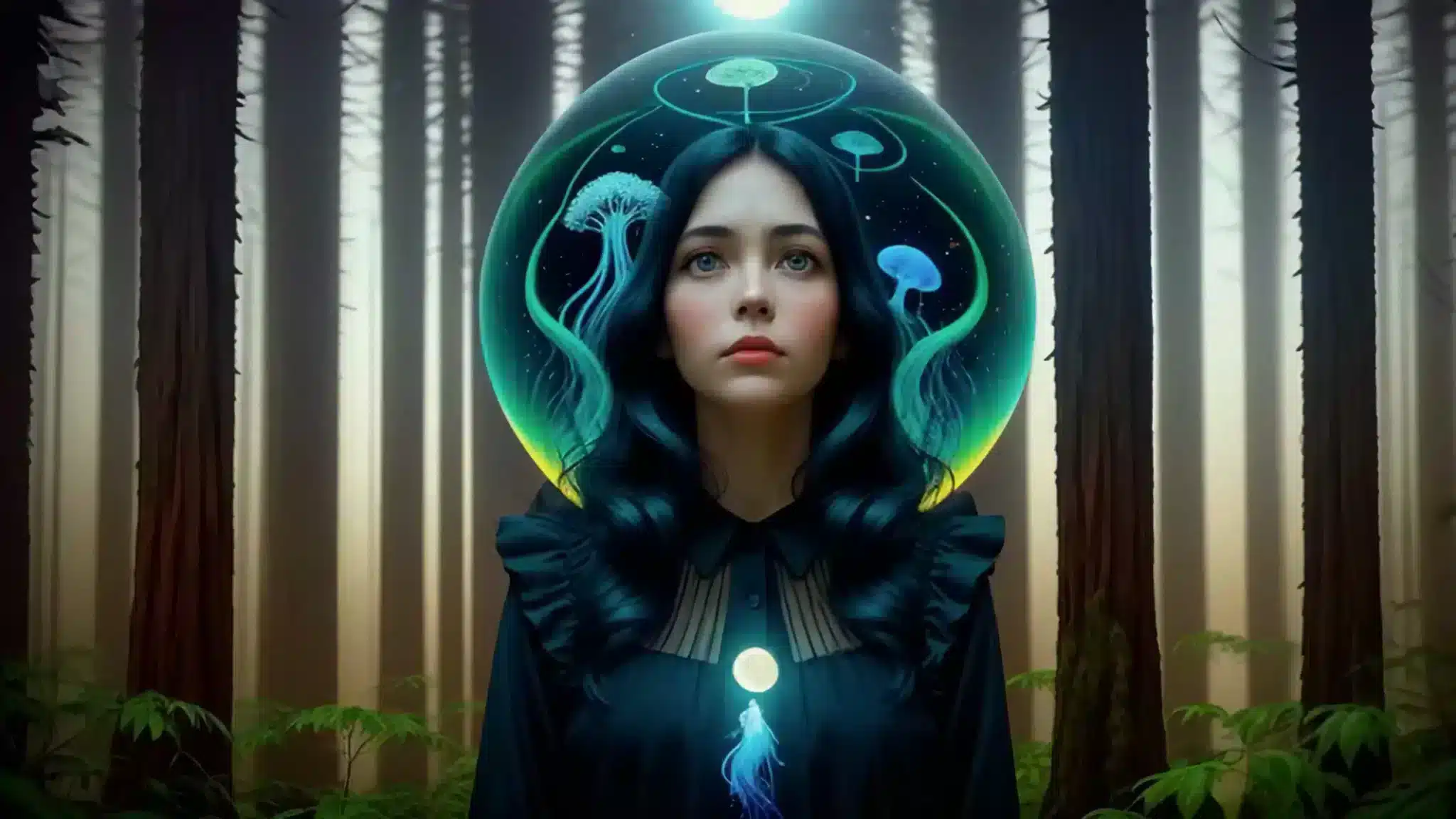
A city folds in on itself. The sky becomes an ocean. Buildings grow like coral, dissolve into smoke, and reassemble as something that has no name. This isn't a glitch. It's a single moment from an AI-generated visual experience — one that runs for twelve hours straight.
This is AI surrealism. And the argument we're going to make is a strange one: this technology might be the most faithful continuation of a 100-year-old art movement that its founders ever could have imagined.
To understand why, you have to forget almost everything you think you know about surrealism.
Surrealism was never about melting clocks
The popular version of surrealism begins and ends with Salvador Dalí. Melting clocks. Elephants on stilts. A flamboyant Spaniard with an impossible mustache.
Dalí is the face of surrealism. He's also the worst possible introduction to it.
Because surrealism was never about weird imagery. It was about the method that produced the imagery.
In 1924, André Breton published the Surrealist Manifesto. His definition was precise:
"Pure psychic automatism, by which one proposes to express the actual functioning of thought. Dictation of thought in the absence of all control exercised by reason."
The key phrase: absence of all control exercised by reason. The surrealists weren't trying to paint weird pictures. They were trying to bypass the conscious mind entirely — to let the unconscious, chance, and accident drive creation.
This is why they developed techniques like automatic drawing (hand moves without conscious direction), frottage (rubbing surfaces to create random textures), and exquisite corpse (collaborative drawing where each artist works blind to the others). Every technique shared one principle: remove conscious control and see what emerges.
Dalí. Magritte. Max Ernst. Leonora Carrington. Remedios Varo. Frida Kahlo. Their work looked radically different — but it came from the same source: art you didn't plan.
Now ask: what generates imagery with less conscious planning than an artificial intelligence?
The machine unconscious
A neural network trains on millions of images — not by memorizing them, but by building a statistical map of how visual elements relate. Generation works backward: the AI starts with noise and iteratively de-noises it until something coherent materializes.
When you push prompts beyond the photorealistic — dreamscapes, impossible architecture, organic-mechanical hybrids — the network finds visual bridges between things that don't normally coexist. A coral reef becomes a cathedral becomes a circulatory system becomes a nebula. Nobody designed these connections. They emerge from statistical relationships so deep that even the engineers can't predict them.
The outputs are coherent but unplanned. Not random — they have internal logic. But nobody composed them.
This is closer to Breton's "pure psychic automatism" than any technique the surrealists themselves invented. Automatic drawing still involves a human nervous system — decades of visual memory, aesthetic preference, muscular habit. AI generation involves no consciousness at all. No memory. No ego. No desire to be liked or understood.
Whether that qualifies as "psychic" is a question for philosophers. That it qualifies as "automatic" is hard to argue with.
The critique — and why it's half right
The artist Allise Nicole wrote a widely-shared essay titled "AI Is Making Surrealism Boring." Her argument deserves engagement.
She's right about this: the internet is drowning in AI images that look vaguely "surreal." Floating objects. Impossible staircases. Dreamlike palettes. Most generated by someone typing "surreal landscape" into Midjourney and posting the first result. The aesthetic has become a filter.
This isn't surrealism. It's surrealism cosplay.
A Midjourney image of a melting clock in a desert isn't surrealism — it's a reference to surrealism. The person typing the prompt made a conscious, rational decision. That's exactly what Breton's manifesto defined surrealism against.
But there's another way to use AI. When a creator uses abstract prompts and curates from thousands of outputs based on emotional resonance rather than aesthetic resemblance — the dynamic shifts. The human becomes a curator of unconscious output from a non-conscious system.
The AI produces. The human selects. Neither follows a rational plan.
The curation is the art. The AI is the unconscious.
Surrealism in motion
Almost every conversation about AI surrealism freezes at still images. But surrealism was never just painting.
In 1929, Luis Buñuel and Dalí made Un Chien Andalou — a film assembled from dream logic, with no narrative structure. Surrealism's first attempt to work in time. The technology of 1929 limited what they could achieve.
AI video generation removes that limitation entirely.
A surreal painting presents one impossible moment. An AI-generated surreal video presents an impossible moment that keeps becoming something else. A landscape dissolves into anatomy. Architecture breathes. Scale collapses and reinflates across minutes that feel like seconds.
Inverted surreal landscapes in 4K. Eleven hours of continuous metamorphosis.
Psytrance Hypnotic Mix 12hTwelve hours of visual experience inseparable from the music surrounding it.
These aren't clips. They're environments — places you enter through a screen and inhabit for as long as you're willing to stay.
Surrealism and music
Erik Satie was the first musician to cross into surrealist territory. His concept of musique d'ameublement — "furniture music" — proposed sound as environment rather than performance. Music that exists in a room the way a painting exists on a wall. The surrealists were obsessed with this idea.
The thread resurfaced in the psychedelic era. Pink Floyd's early work. Tangerine Dream. The Krautrock movement — Can, Faust, Neu! — drawing on surrealist principles without claiming the label. Captain Beefheart's Trout Mask Replica (1969), composed through deliberately automatic processes and explicitly influenced by Dalí and Ernst, is arguably the most surrealist-adjacent album ever recorded.
Modern electronic music — ambient, psytrance, IDM, dark techno — carries this lineage forward. These genres are architectures of perception. They don't describe experience. They alter it.
Add AI-generated surreal visuals — a twelve-hour visual environment evolving in ways you can't predict, streaming in 4K behind a DJ at 2AM — and you have something the surrealists could only have dreamed of: sight and sound operating together, across hours, to bypass rational perception entirely.
Where this goes next
Real-time generation is approaching. AI systems that generate surreal visual environments live, directly from audio input. Every beat producing a visual moment that has never existed before.
Responsive environments will follow. Spaces where movement, biometric data, or mood influences what the AI generates. Surrealist experiences that are literally different for every person.
Accessibility is already here. Surrealist visuals are no longer locked in galleries. They're streaming in 4K in bars, on festival stages, in yoga studios, on the screens of 8 million views worth of audiences who encounter them through music.
André Breton wanted art that bypassed rational control. He had automatic drawing and collage. A century later, we have systems that generate continuous visual narratives from pure mathematics — no consciousness, no intention, no ego — projected onto the walls of nightclubs and festival stages across four continents.
If that's not surrealism, the word has lost its meaning.
Explore further
Psychedelic Visuals
Browse the AI-generated collection by intensity level.
Best Surreal Visuals for Music
Compare every source — stock, YouTube, AI tools, and streaming.
Visuals for DJs
Genre-matched visuals for live performances.
AI-Generated Originals
How the AI generation process produces unique content.
Experience AI surrealism in motion
Reading about surrealism is understanding. Watching a landscape dissolve and reassemble for three hours is experiencing it.
Frequently asked questions
What is AI surrealism?
A contemporary art form that uses artificial intelligence to generate dreamlike, impossible, and emergent visual experiences in the tradition of the surrealist movement. It combines AI generation — which produces imagery without conscious intention — with human curation to create content that embodies André Breton's original principle of "pure psychic automatism."
Who started the surrealism movement?
André Breton with his Surrealist Manifesto in 1924. The movement grew from Dadaism and Freud's theories of the unconscious. Key artists include Salvador Dalí, René Magritte, Max Ernst, Leonora Carrington, Remedios Varo, and Frida Kahlo.
Is AI art really surrealism?
It depends on how it's made. AI imagery that copies the surface of surrealism from a deliberate prompt is pastiche. But when AI generates genuinely emergent imagery and a human curator selects for emotional resonance rather than aesthetic resemblance — the process mirrors the surrealists' own methods more faithfully than most human techniques.
How is AI surrealism different from psychedelic art?
Psychedelic art draws from altered-state experiences — kaleidoscopic patterns, saturated color, geometric symmetry. Surrealism draws from dreams and the unconscious — impossible scenes, unexpected juxtapositions, narrative strangeness. AI surrealism often blends both traditions.
Can I experience AI surrealism?
Yes. Surrealism.ai offers 20+ AI-generated surreal visual experiences in 4K, running up to 12 hours. You can also find AI surrealist content on YouTube or generate your own with tools like Neural Frames.